



Blog
Family SUV Import Guide: US to Europe via DreamBid
cars at live US auctions right now
Bid yourself or buy instantly — delivery and customs included in the calculator
The popular advice is simple: choose the biggest three-row SUV you can afford. That rule fails many families. A usable family SUV must combine safe handling, practical child-seat access, cargo space with every seat occupied, and a landed cost that still makes sense after transport, tax, repairs, and European compliance work.
For Polish buyers importing from the United States, the right vehicle is rarely the one with the most seats. It's the one whose cabin geometry, engine displacement, condition history, and total import cost fit everyday life. That means checking ISOFIX locations, measuring boot space behind the third row, reading auction damage codes, and calculating Polish excise before placing a bid.
Table of Contents
- Redefining the modern family SUV
- Evaluating safety and child-seat compatibility
- Navigating European registration and tax rules
- Calculating total import costs with DreamBid
- Assessing auction risks and vehicle history
- Comparing clean-title and salvage import strategies
- Executing your import plan step by step
Redefining the modern family SUV
The family SUV has moved from specialist choice to mainstream family-car format. In the United States, SUVs represented 58% of all vehicles produced in model year 2023, and the EPA notes that their production share has increased in all but 10 years since 1975. In the European Union's five largest automotive markets, SUVs gained nearly 20 percentage points of market share over the past six years, reaching 58.25% in 2025 in JATO's summary chart. The same direction is visible in American sales, where SUVs reached 52% of new-vehicle sales in 2025, compared with 46% in 2021 and 38% in 2016. These figures are documented in the EPA vehicle production analysis.
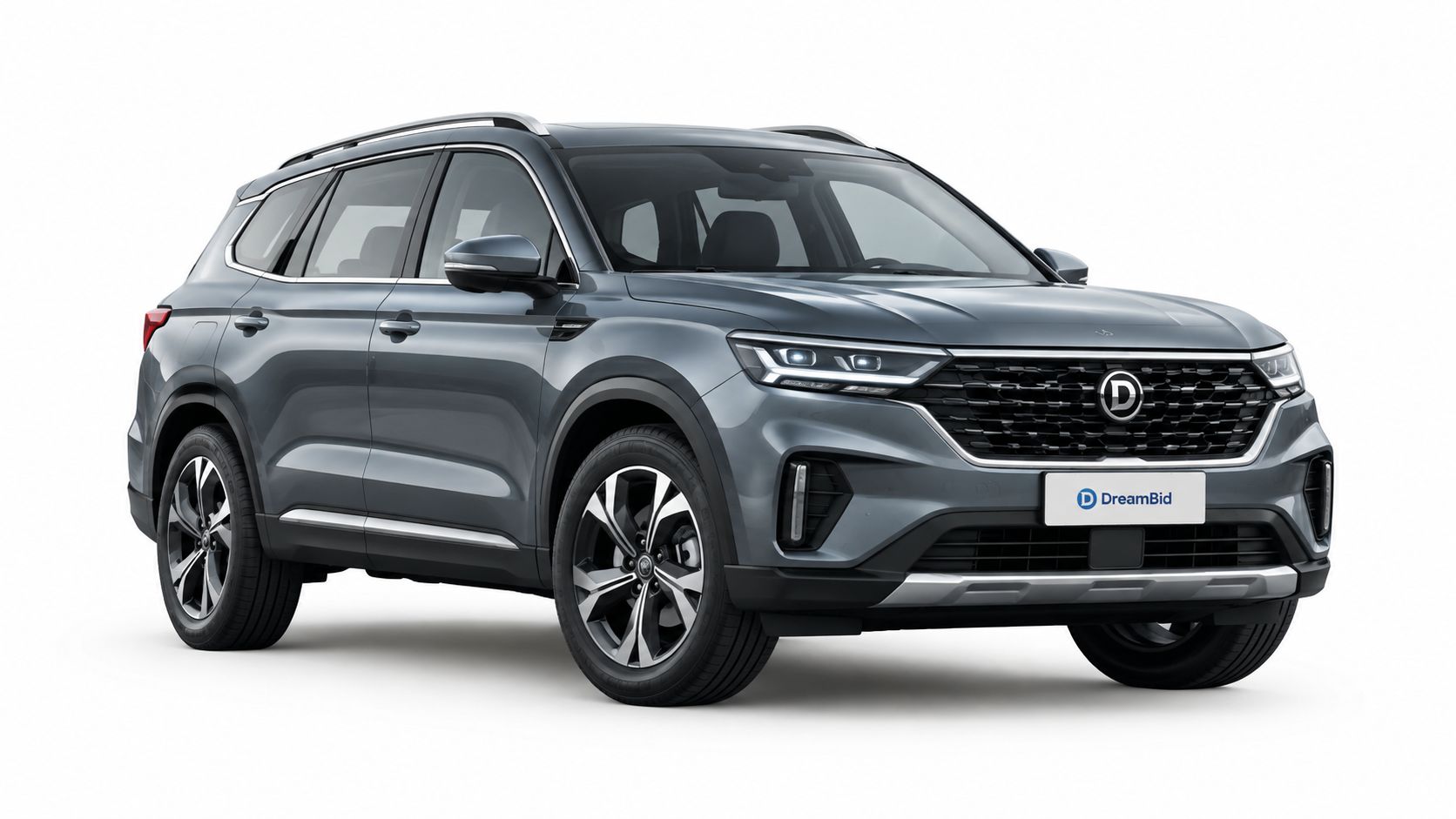
That market shift reflects practical preferences. Families often want a higher seating position, easier access to child seats, flexible cargo arrangements, and the option of carrying more passengers. A US family SUV can also offer equipment and cabin space that's difficult to find at the same purchase price in the European used-car market.
Yet three rows create a compromise that advertisements often hide. With every seat raised, the remaining cargo area may be too small for the equipment a family carries. The Toyota Grand Highlander provides about 14.5 cubic feet behind the third row, while the standard Highlander provides only 8.6 cubic feet, according to Consumer Reports' measured cargo-room guide. The larger vehicle offers more usable space in this comparison, but the broader lesson is more important than the model name.
Practical rule: Measure the boot with the third row raised. Folded-seat capacity matters less if your stroller, luggage, or sports equipment travels with all passengers onboard.
A two-row SUV may be the better family vehicle if the third row would be used only occasionally. Current family-car commentary also points to a more practical buying environment in 2026, with families paying closer attention to borrowing costs, daily ergonomics, rear-seat ventilation, charging access, and total ownership cost. A compact or mid-size SUV with properly positioned child-seat anchors can be more useful than a larger seven-seater that forces awkward access and sacrifices luggage space.
For a broader look at vehicles suited to larger households, see this guide to cars for large families from the USA. The useful question isn't “How many seats does it have?” It's “Can my family load everyone, secure every child, and carry what we need without turning every journey into a compromise?”
Evaluating safety and child-seat compatibility
Safety has two separate dimensions in a family SUV. The first is crash performance and vehicle stability. The second is whether parents can install and use child restraints correctly every day. A vehicle can perform well in a collision and still be frustrating or unsafe if its anchors are hidden, its doors don't open wide enough, or a rear-facing seat leaves no usable space behind the driver.
Electronic stability control is especially important in a taller vehicle. ESC detects understeer or oversteer and applies braking to individual wheels to help keep the SUV aligned with the driver's intended path. Safety guidance links ESC with about a 50% reduction in fatal single-vehicle crashes, with particular relevance to SUVs because their taller bodies have a higher centre of gravity and greater rollover exposure during emergency manoeuvres. The technical explanation and safety context are outlined in this ESC and rollover safety guide.
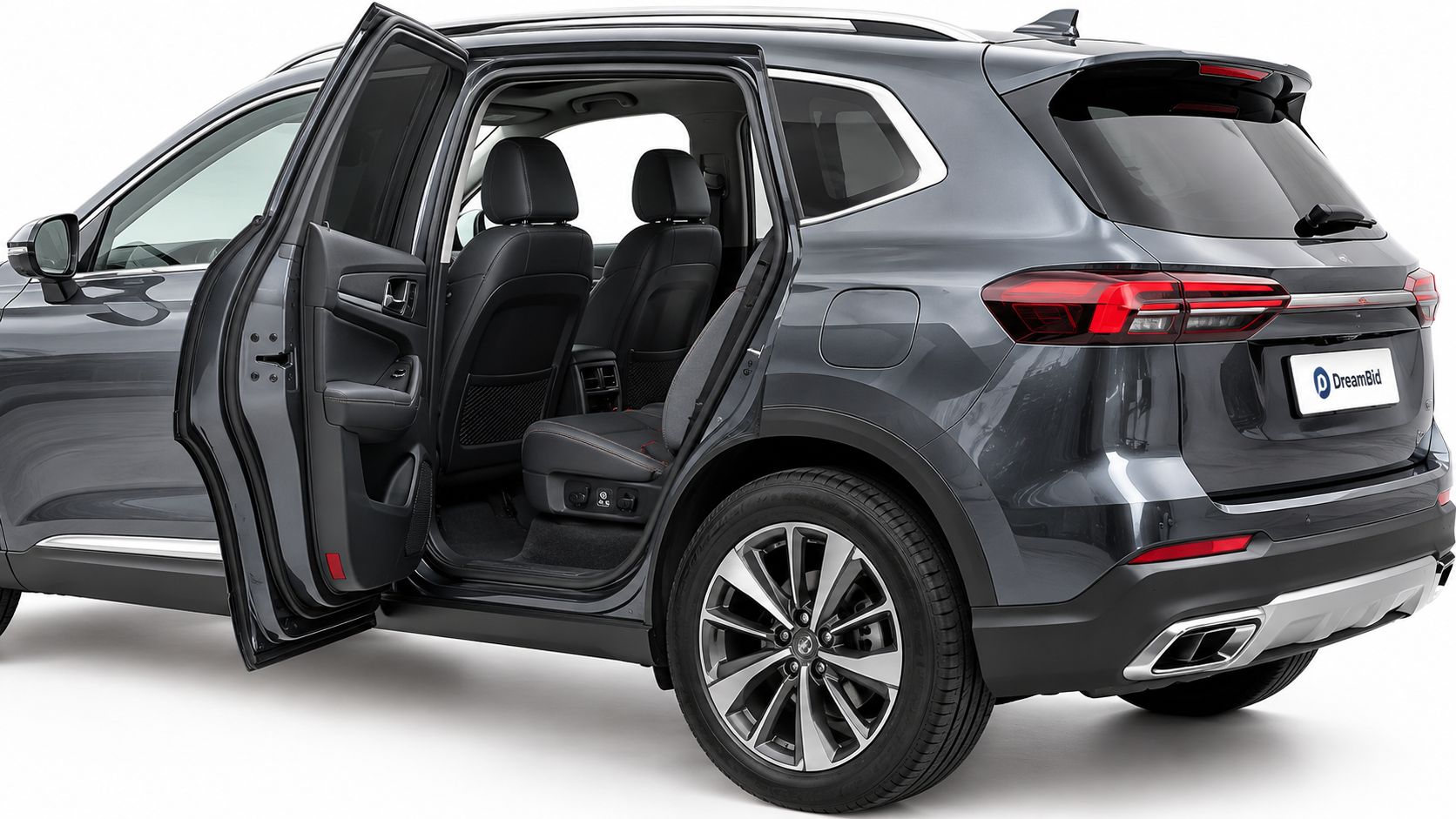
Modern SUVs have a much improved safety record compared with their early growth period. The Insurance Institute for Highway Safety reports that, in 2024, SUVs had the lowest occupant death rate among passenger-vehicle types in both single-vehicle crashes, at 10 deaths per million registered vehicles, and multiple-vehicle crashes, at 17 deaths per million registered vehicles. IIHS also says occupant death rates have fallen across all passenger vehicle types since 1978, with the largest declines among SUV occupants. These figures come from the IIHS passenger-vehicle occupant fatality statistics.
Child-seat layout matters more than seat count
A three-row family SUV should be assessed with the child seats installed, not with an empty cabin. Before bidding, check:
- Rear-facing clearance: Confirm that a rear-facing seat fits behind a tall driver or front passenger without forcing an uncomfortable seating position.
- Anchor distribution: Check whether ISOFIX points and top-tether anchors exist in the second and third rows, not just in the outer second-row seats.
- Third-row access: Test whether children can reach the third row while second-row child seats remain installed.
- Cabin width: Verify that two restraints can sit side by side without blocking buckles or making daily fastening difficult.
- Seat configuration: Determine whether access requires removing or folding a second-row seat that already carries a restraint.
The practical difference between models can be substantial. Some seven-seat SUVs don't provide child-seat anchors in the third row. Others require second-row reconfiguration before passengers can reach the rear seats. A smaller SUV with better ISOFIX placement and wider access can therefore work better than a larger model with a nominally higher passenger count. Buyers who need to verify an imported vehicle's history should also use a structured VIN check for a car from the USA, then confirm the physical cabin layout before committing.
Navigating European registration and tax rules
A US family SUV isn't ready for Polish roads just because it has arrived at a European port. The landed vehicle must pass through customs, fiscal settlement, technical adaptation, inspection, and registration. The exact route depends on the buyer's situation, the port used, the vehicle's documents, and the applicable tax treatment.
Polish excise is the most important early filter for many imported SUVs. Passenger cars with engines up to 2,000 cm³ fall into the 3.1% excise band, while engines above 2,000 cm³ fall into the 18.6% band, as set out in the Polish vehicle registration tax guidance. Certain hybrids and plug-in hybrids may receive reduced or exempt treatment, so engine displacement alone doesn't settle the calculation.
The threshold can change the economics of two otherwise similar vehicles. A 2.0-litre turbocharged family SUV may carry a much lower excise burden than a comparable V6 above the threshold. The correct comparison isn't the auction price. It's the final cost after customs duty, VAT, excise, shipping, repairs, technical work, and registration-related expenses.
Check the compliance work before bidding
US-market lighting frequently requires adaptation to European standards. Headlamp beam patterns, rear lighting, indicators, and the installation or configuration of a rear fog light may need attention before the vehicle can pass inspection. The required work depends on the specific model and its equipment, so a repair estimate should include a European compliance inspection rather than focusing only on collision repairs.
A normal import chain includes:
- Auction purchase and title handling, followed by collection from the US auction yard.
- US inland transport, usually by truck to an export warehouse or shipping terminal.
- Container ocean freight to a suitable European port.
- Customs clearance, including customs duty and VAT under the selected route.
- Polish excise settlement, based on engine displacement and any applicable hybrid treatment.
- Repairs and EU modifications, including lighting and other technical requirements.
- Inspection, registration documentation, and regional flatbed delivery to the buyer.
Clearance may be arranged through a German port such as Bremerhaven for specific VAT structures, or through a Polish port such as Gdynia when domestic clearance is more appropriate. This choice should be made before shipping, because routing affects paperwork, transport legs, and fiscal handling.
Calculating total import costs with DreamBid
The only safe bidding limit is based on the landed and road-ready cost, not the auction hammer price. A family SUV that looks attractive on the auction screen can lose its advantage after inland towing, buyer fees, ocean freight, customs, VAT, excise, repairs, lighting adaptation, inspection, and final delivery are included.
A transparent calculator should build the estimate in sequence:
- Auction amount: Include the planned maximum bid and the platform's applicable auction charges.
- US inland transport: Add the cost of moving the SUV from the auction yard to the export or container location.
- Ocean freight: Account for container shipping and the selected European arrival port.
- Customs and VAT: Apply the relevant customs and VAT treatment to the import route.
- Polish excise: Use the correct displacement band, then check whether the vehicle qualifies for hybrid treatment.
- Repair and compliance allowance: Include bodywork, mechanical diagnosis, lighting adaptation, rear fog-light work where required, and inspection preparation.
- Final delivery: Budget for regional flatbed transport from the port, warehouse, or workshop to the client's address.
For general background on the final leg, this resource on door-to-door vehicle shipping cost helps explain why delivery should be treated as a separate transport component rather than assumed to be included in the purchase price.
Set the bid from the finished vehicle backwards
The useful workflow is to decide what the repaired, registered SUV may reasonably cost, reserve money for unknowns, and then calculate the maximum auction bid that fits. Don't let a low displayed price override the tax implications of a larger engine or the repair burden of a particular damage type.
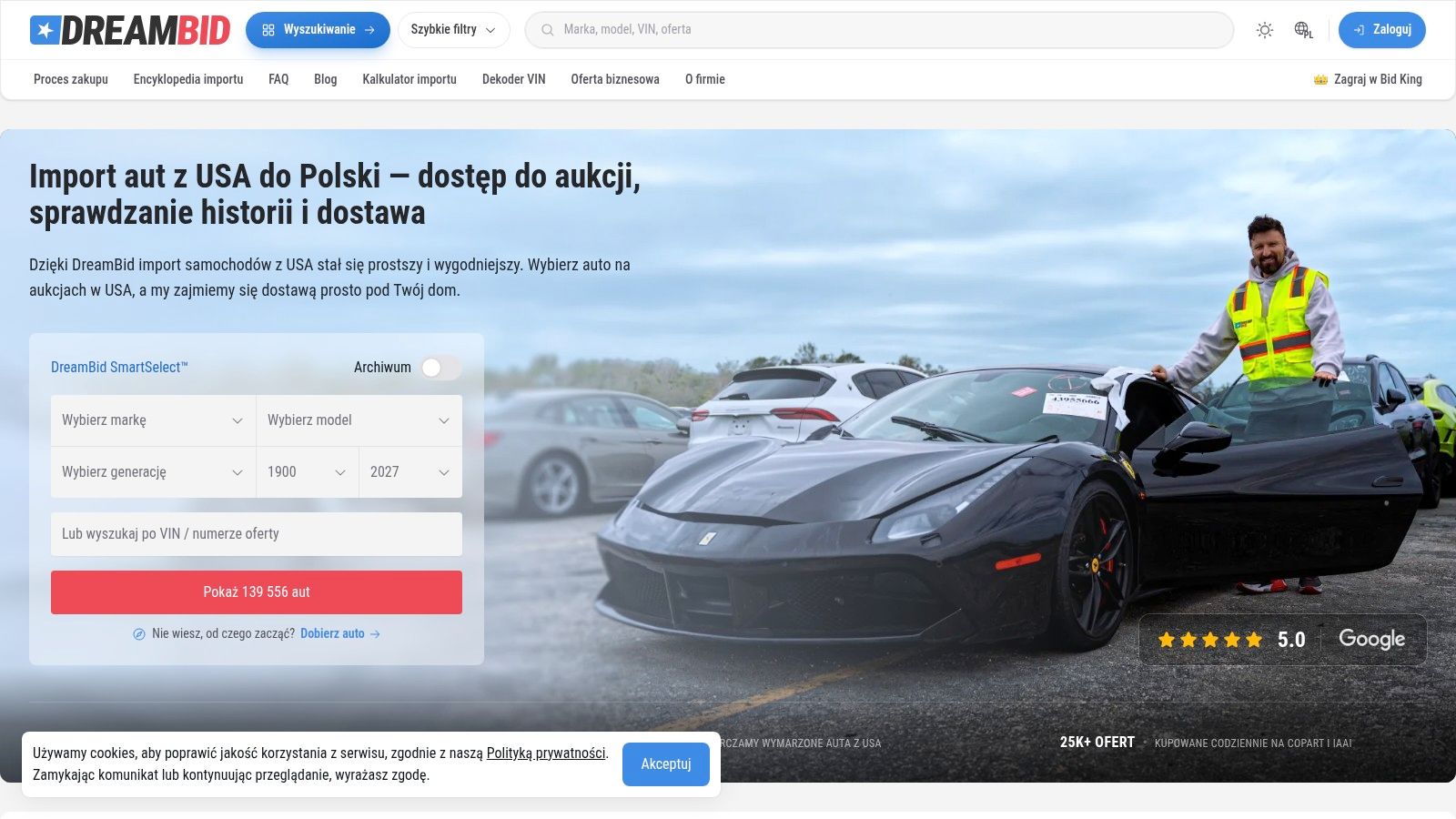
DreamBid's import cost calculator for cars from the USA is designed to itemize auction fees, US transport, ocean freight, customs duties, VAT, and Polish excise before bidding. Its operating model combines online access to Copart and IAAI listings with human import support, milestone updates, and export-warehouse photographs. The stated service fee is a fixed 1,999 PLN net, rather than a variable middleman commission.
The calculator doesn't remove repair uncertainty. It gives that uncertainty a place in the decision. Add a written repair assessment, confirm the title and damage category, and keep a reserve for parts availability, workshop findings, and European compliance work. For a family vehicle, reliability after repair matters more than winning a particular auction lot.
Assessing auction risks and vehicle history
Auction photographs are evidence, not a complete diagnosis. A family SUV may show a manageable front-end impact, but the same image can conceal bent rails, damaged suspension mounting points, deployed airbags, or cooling-system damage. The safest assessment combines the listing, VIN history, title information, close inspection of the photographs, and a repair plan prepared by someone familiar with US-market vehicles.
Copart uses standardized condition labels that help establish an initial risk category. Its public glossary includes FR for front end, HL for hail, MC for mechanical, MN for minor dents and scratches, NW for normal wear, and FD for frame damage reported. The definitions are available in Copart's vehicle-condition glossary. These labels don't replace inspection, but they help separate mainly cosmetic damage from listings that deserve structural or mechanical caution.
Read the damage in layers
Start with the obvious impact zone, then look beyond it. Misaligned bonnet gaps, uneven door shut lines, cracked windscreen edges, displaced wheels, and missing underbody panels can indicate that the damage extends beyond visible cosmetic areas. Airbag deployment is another major clue, especially when the dashboard, steering wheel, curtain airbags, and seat-belt pretensioners appear affected.
Flood damage requires a different inspection. Look for water lines, corrosion under seats, oxidation in connectors, damp carpet, residue in storage compartments, and inconsistent electrical warnings. A vehicle with apparently light body damage can become a long-term problem if water has reached control modules and wiring.
Use the VIN as a decision tool
A VIN report should be checked against the auction description and photographs. Look for title branding, prior sale records, mileage consistency, reported theft or flood history, and evidence that the vehicle has moved through multiple auctions. The report can't tell you everything, but contradictions deserve a lower bid or a complete rejection.
For a family SUV, mechanical risk has a higher cost than cosmetic inconvenience. A repaired bumper is visible and finite. Intermittent restraint-system faults, cooling problems, or water-damaged electronics can compromise safety and consume workshop time long after registration.
Inspection discipline: If the photos cannot answer whether the frame, suspension, airbags, and electronics are sound, treat the vehicle as unverified, not as “probably fine.”
Comparing clean-title and salvage import strategies
Clean-title and salvage imports suit different buyers. A clean-title SUV may reduce documentation and repair uncertainty, but it can still carry hidden mechanical wear, previous poor maintenance, or auction-related cosmetic issues. A salvage SUV may offer a stronger purchase opportunity when the damage is clearly documented and the repair route is realistic, but it demands better technical judgment and tighter cost control.
The right choice depends on how the vehicle will be used. A family that needs immediate, predictable transport may value a cleaner history and a shorter repair process. A buyer with a trusted workshop, access to parts, and patience for rebuilding may accept documented front-end damage if the structural condition is sound.
Import strategy comparison
| Factor | Clean-title import | Repairable salvage import |
|---|---|---|
| Documentation | Usually simpler to interpret, although the VIN still needs checking | Requires careful review of title branding and damage records |
| Visible condition | May have cosmetic wear or undisclosed mechanical needs | Damage is often more obvious, but hidden structural or mechanical issues remain possible |
| Repair burden | Often limited to service, inspection, and EU adaptations | Can include bodywork, airbags, suspension, cooling systems, and lighting conversion |
| Financial control | More predictable before shipping | More sensitive to parts, labour, and workshop findings |
| Best suited to | Buyers prioritizing usability and lower repair involvement | Buyers with technical support and a disciplined repair budget |
| Family-use concern | Confirm maintenance and safety-system condition | Confirm that repairs restore restraint systems and structural integrity |
A lightly damaged salvage vehicle can be preferable to a clean-title car with expensive mechanical neglect, but only when the damage category and photographs support that conclusion. “Salvage” isn't a diagnosis. It's a signal to investigate more.
The same applies to clean titles. A clean document doesn't prove that a vehicle has never suffered serious wear or that its US lighting and equipment will meet European requirements. Check the VIN, arrange a technical review, and price the conversion work before comparing the two strategies.
For most private family buyers, the sensible middle ground is a vehicle with clearly photographed, repairable damage, a consistent history, no flood indicators, and a workshop quotation based on actual parts. That approach avoids paying for an unknown problem while keeping the decision grounded in evidence.
Executing your import plan step by step
Start with the family's actual requirements. Decide whether you need two rows or three, how many child restraints must remain installed, whether a rear-facing seat must fit behind a tall driver, and how much luggage space is required with every passenger present.
Then follow a controlled process:
- Create a DreamBid account and define the search around suitable SUV sizes, engines, title types, and damage categories.
- Set alerts for specific models, rather than browsing every large SUV on Copart or IAAI.
- Review the VIN and photographs before considering a bid. Reject flood indicators, unexplained structural damage, and cabin layouts that don't support your child-seat configuration.
- Run the full cost calculation using the auction price, inland transport, container freight, customs, VAT, excise, repairs, compliance work, and final delivery.
- Place a disciplined bid that stays below the calculated maximum. A successful purchase is one that remains financially sound after arrival.
- Complete the broker and transport paperwork after the auction, then confirm collection, container loading, and the chosen European clearance route.
- Track each milestone, including warehouse inspection photographs, shipping progress, customs processing, repair, and flatbed delivery.
The full sequence is also set out in this guide to importing a car from the USA. Buyers managing several vehicles or business operations can use broader fleet compliance material, such as this overview of HGV fleet new vehicle setup, while remembering that passenger-SUV registration has its own Polish and EU requirements.
DreamBid combines online auction access, VIN analysis, cost calculation, logistics coordination, and human import support. The platform has operated with more than 10 years of import experience and reports thousands of processed vehicle transactions, with visual milestone updates including export-warehouse photographs.
Visit DreamBid to compare US family SUVs, check their histories, and calculate the complete route to Poland before bidding. Use the platform's cost breakdown and import support to choose a vehicle based on child-seat usability, tax exposure, repair risk, and final road-ready value.